
The operating problem
Services firms cannot keep adding headcount every time revenue, complexity, or reporting demand increases. Scattered AI pilots rarely fix that math because they are disconnected from ownership, workflow controls, adoption, and operating measures.
The outcome
The Peak Operating Loop gives leadership one system for deciding what AI should handle, what people must own, how each workflow is governed, and whether the economics actually improved. It is designed for $10M to $250M federal and regulated services firms that need revenue to grow faster than headcount without weakening quality or trust.
Proof in practice
We run the Loop ourselves.
The Peak Operating Loop is not just client methodology. Jupiter Peak runs on the same principle: human judgment at the center, with internal AI agents handling repeatable sensing, mapping, analysis, and drafting work around it.
The result is a solo advisory model with the operating capacity of a larger team — without the handoffs, junior staffing layers, or incentive to bill unnecessary hours.
Why now
Services firms are entering the first operating-model shift since cloud and SaaS. The firms that win the next decade will not simply adopt AI; they will redesign how the firm senses, decides, executes, and learns. Firms that do not will not just be less efficient. They will be structurally slower.
What AI-native means
An AI-native firm is not a firm that uses AI tools. It is a firm where people, agents, data, workflows, and strategy operate as one managed system. Tools are everywhere; integration into the operating model is what makes a firm AI-native.
The Economic Test
The Peak Operating Loop passes its quarterly Economic Test only when at least one economic outcome, at least one flow or leverage measure, and at least three of the five measures improve; no measure materially degrades; and all three guardrails hold:
- Revenue per employee
- Gross margin
- Proposal and sales cycle time
- Delivery cycle time
- Management attention required per dollar of revenue, measured through six controlled categories: escalations, recurring decisions that should be governed by process, avoidable meetings, single-leader dependencies, unplanned interventions, and approval exceptions against the delegation-of-authority path
The Economic Test is evaluated quarterly over a rolling four-quarter window against the Economic Baseline. It cannot pass if client retention or net revenue retention, delivery quality, or regrettable employee attrition materially degrades over the same window. Management attention is recorded through a controlled weekly log, normalized per $1 million of trailing-twelve-month revenue, corroborated in at least one category from a system of record, and reported with Log completeness.
Every installation records its mix of firm-fixed-price, cost-reimbursable, time-and-materials, and productized or outcome-based work before targets are set. The Route declares whether to score the addressable portfolio, make contract-mix shift a Move, or use approved substitute measures. The rule cannot change inside a measurement window except through Adapt.
AI-native transformation is not measured by how many tools are deployed. It is measured by whether the firm can grow revenue faster than headcount while improving quality, speed, and trust.
The signature principle: define the win condition first
Nothing gets built until success is defined. Not the annual plan, not a quarter's priorities, not a single workflow, not an individual AI agent. Before any work begins, the win condition names what done looks like, the accountable owner, how success is measured, the deadline or decision date, and the proof required. This is the discipline that keeps AI from becoming a pile of impressive demos that never reach production.
The Core: what changes rarely
The Strategic Core is set deliberately and changes rarely.
The Summit is the transformative reason the firm exists, beyond the next contract. One sentence, specific enough that any piece of work can be tested against it. The Summit answers whether the firm's ambition is linear (more contracts, more headcount) or exponential (more leverage per person).
The Field and the Buyer define the operational positioning. The Field is the segment the firm plays in. The Buyer is the specific role sold to inside that segment. Together they filter every signal the Sense Layer surfaces and every Move the firm pursues. A Field that includes everything filters nothing.
The Edge and the Approach define what makes the firm distinctive and how it delivers. The Edge is three structural differentiators (not aspirational platitudes). The Approach is the named, repeatable methodology the firm runs every engagement against. An optional Promise names a specific outcome commitment.
Values and Operating Rules govern how the firm behaves at runtime. Jupiter Peak starts installations from a six-value default, but a firm may tailor the set to its needs while retaining at least three values. Every value requires both a human runtime rule and an agent runtime rule. Values that don't run at runtime are decoration.
The Long View and Annual Aim connect the three-to-five-year picture to a small set of annual outcomes. The Long View includes both a leverage ratio and a structural-leverage indicator; every Annual Aim outcome has a win condition.
The Loop: what runs continuously
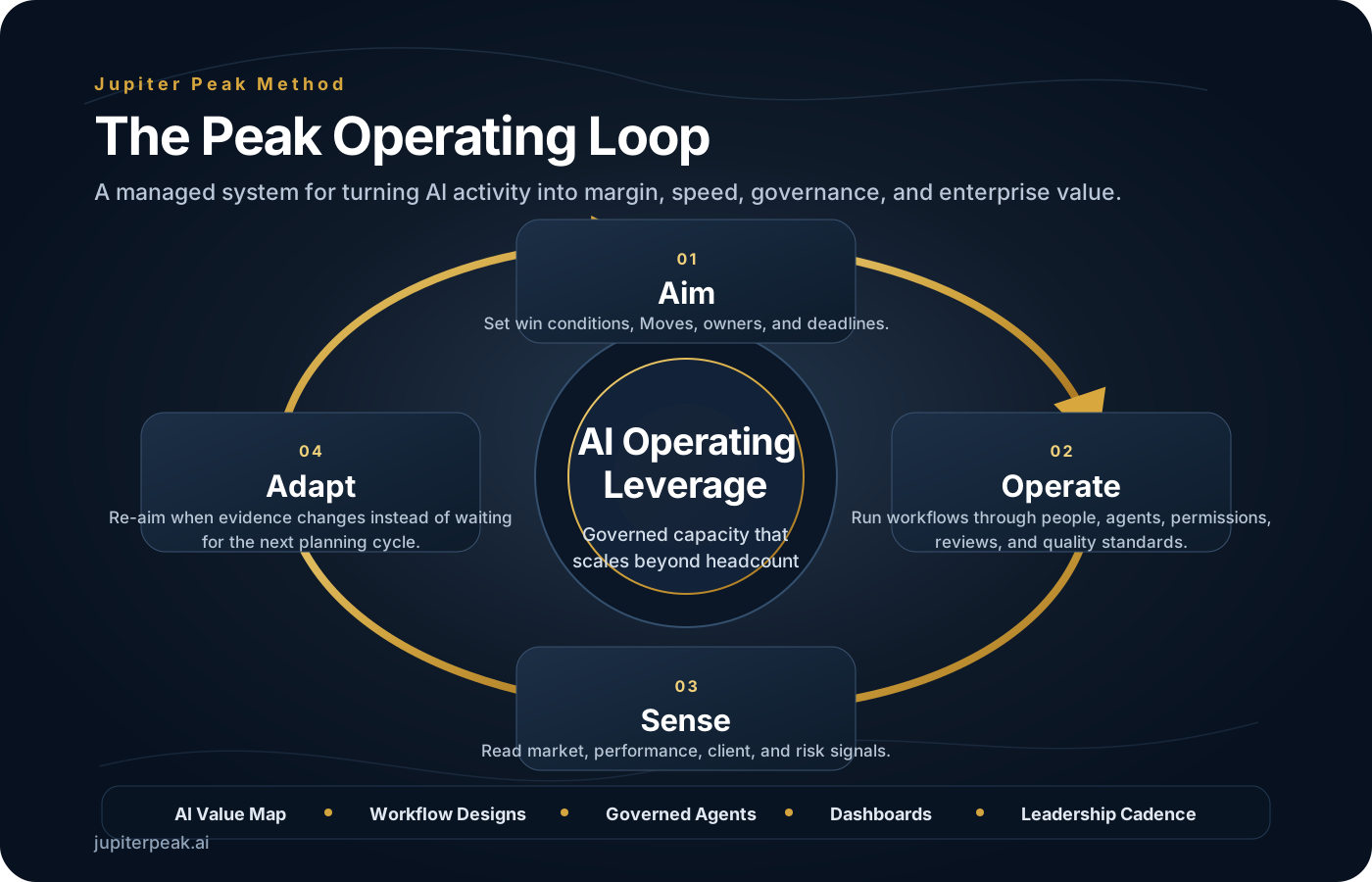
Four stages run continuously, AI-accelerated. The complete Route holds both the stable Strategic Core and the live Loop Dashboard view.
Aim. Set the Long View, Annual Aim, and current Moves. Moves are adaptive hypotheses, not frozen quarterly commitments. Every Move carries a win condition, revision or stop condition, and an economic claim naming which Economic Test measure it should move, in which direction, and by approximately how much.
Operate. Execute through accountable human, agent, and hybrid seats governed by the Two-Layer Operating Model. The Operating Seat Map represents the complete operating organization as an allocation of capacity, not a reporting hierarchy. Human-led and hybrid seats require a named accountable person, mandate, win condition, capabilities, capacity, and review cadence. Managed-agent seats meet eleven requirements covering business ownership, mandate, win condition and economic claim, permissions, external-action boundaries, escalation, output contract, quality, review cadence, logging and retention, and retirement or re-scope.
Operate runs on a weekly leadership cadence called the Loop Meeting. Without the Loop Meeting, the methodology is a framework. With it, the methodology is a system. The Loop Meeting works from the Loop Dashboard as its single operating view. Its fixed agenda is: opening and material changes; Economic Test measures and trajectory; Move owner on-track/off-track review; customer, employee, agent, market, values, and governance headlines plus reconciled Sense; task owner on-track/off-track review; Adapt problem-solving using identify, discuss, and solve; and a conclusion with decisions, commitments, cascading messages, and a meeting rating.
Sense. Continuous review reads the market, performance, competitive moves, internal signals, and value alignment. Every required review function records a finding or explicit disposition in the Signal Register. Level 1 remains registered for monitoring; Level 2 enters active Sense; Level 3 links to Adapt; Level 4 links to an immediate Re-Aim Adapt item.
Every installation covers seven universal review functions: Values, Marketing Strategist, Customer/Buyer, Market, Governance/Risk, Operating Performance, and Weekly Improvement and synthesis. Managed-agent implementation is the default and functions may be combined when ownership remains explicit. A human or hybrid implementation is permitted only when a documented data-rights, privacy, or regulatory constraint precludes an agent. Read more about the Values review function
Any signal proposed at Level 3 or above is scored on evidence, magnitude, confidence, urgency, and reversibility before leadership discussion. Level 4 also requires a documented reason why waiting until the next planning boundary is economically worse. That burden is the control against signal whipsaw.
Adapt. Leadership uses the signal from Sense to adjust the Aim faster than any calendar would allow. When a signal warrants it, the firm re-aims between planning cycles rather than waiting for the next offsite. Two workflows handle this: the Adapt Workflow (Level 3 signals or off-track Moves) and the Re-Aim Workflow (Level 4 signals that change current-quarter priorities, resourcing, or offer strategy).
The operating cadence
Most operating systems run on a meeting-heavy calendar: annual offsite, quarterly planning, monthly reviews, weekly stand-ups. The Peak Operating Loop combines an annual Aim Meeting, a weekly Loop Meeting, and an extended Quarter-Boundary Loop Meeting. Adapt and Re-Aim work remains signal-triggered.
The weekly Loop Meeting is the operating heartbeat (described above).
The Annual Aim Meeting updates the Long View and Annual Aim and maps the initial high-level quarterly Move path. The first Weekly Loop Meeting of each quarter is an extended Quarter-Boundary Loop Meeting that runs the quarterly Economic Test and claims ledger, reviews guardrails, revises Moves, reviews the Operating Seat Map, reallocates capacity and budget, and sets the next 90-day targets. It is a designated instance of the Weekly Loop Meeting, not a third meeting type.
Everything else (Adapt Workflows, Re-Aim Workflows, agent installs and retirements) is triggered by signals crossing thresholds, not by the calendar. This is the methodology's defining difference from traditional operating systems. Calendar drag (waiting for the quarterly offsite to react to the market) is one of the failure modes the Loop exists to prevent.
The Loop Dashboard: one operating view
The Loop Dashboard is the leadership team's single operating view. It surfaces Economic Test measures and weekly trajectory, company-stage leading indicators, current Moves, reconciled Sense signals, open Adapt items, priority tasks, owners, deadlines, data freshness, and reconciliation status.
The dashboard is published as a pre-read before the Weekly Loop Meeting. It distinguishes source-data time from render time and fails readiness when required sources are missing, stale, unreconciled, or inconsistent. A ready pre-read permits segments 2, 3, and 5 to run by exception; a failed dashboard removes that option.
The 90-day trajectory is the weekly leading view against current targets. It asks whether the firm is moving toward economic leverage. The quarterly Economic Test asks whether leverage occurred. They are distinct and are not reported interchangeably.
The five Core Artifacts
The methodology installs through five artifacts, which together form the firm's Route, the canonical document the leadership team operates from:
The Economic Baseline. The five starting numbers, captured before any change.
The Summit and Field Map. The Summit, Field, Buyer, Edge, Approach, and Promise on one page.
The Move Scorecard. Current Moves with owners, win conditions, evidence, revision conditions, and economic claims.
The Operating Seat Map. Every required company capability and accountable human, managed-agent, or hybrid seat, governed by the applicable seat standard.
The Loop Dashboard. Economic Test measures and trajectory, Move status, reconciled signals, Adapt items, tasks, owners, deadlines, and readiness.
What the Loop prevents
The methodology exists to prevent nine failure modes that quietly kill services-firm growth:
AI demo theater. Impressive prototypes that never reach production, while the firm tells itself it is doing AI.
Tool sprawl. A pile of disconnected subscriptions, none of which anyone owns or can decommission.
Agent risk. Autonomous actions taken in your name, by software with no escalation path and no human accountable for what it does.
Strategy drift. A pipeline of opportunities outside your Field and Buyer that wins enough revenue to feel good and loses enough margin to hide the problem.
Calendar drag. The firm learns about the market at the quarterly offsite, two months after the firms that act on it.
Headcount gravity. The only way you have ever grown is by hiring, and you are approaching the wall where that math stops working.
False completion without user-visible proof. Work reports done without an inspectable result.
Repeated leadership drag caused by controls that do not learn. The same review gate fails the same way while the rule behind it never changes.
Signal whipsaw. Leadership re-aims on every strong signal, presenting as adaptability and behaving as having no plan.
Four ways to install the Loop
Operating Snapshot (free, five minutes). Try the methodology on your own firm. The coach asks a handful of questions and produces a personalized first-sketch of your operating plan. See your firm on the Loop
AI Opportunity Assessment ($5,000 fixed-fee diagnostic). A paid diagnostic that captures your Economic Baseline, identifies and ranks your AI opportunities, and delivers a 90-day execution roadmap. Review the Assessment
One-to-one Advisory. Private engagement to install the Loop end to end, from the Economic Baseline through the first Loop Meeting. Book a Fit Call
The Federal AI Operators Cohort. Application-first peer-group installation for federal services operators. Tuition is $10,000 per firm; schedule and cohort dates will be announced after the application phase. Apply to the cohort
How the Peak Operating Loop is different
Operating systems like EOS run on a human-speed calendar: plan annually, set priorities quarterly, revisit at the next meeting. They are disciplined but calendar-bound. Exponential-organization thinking theorizes leverage but predates the tools that deliver it.
The Peak Operating Loop adds the part neither has: a continuous, AI-driven sensing and adaptation cycle that compresses the strategy loop from quarters to weeks. The discipline is not in tension with the leverage. The discipline is what makes the leverage real, and the continuous loop is what makes the firm exponential rather than merely well-run.
Frequently asked questions
What is the Peak Operating Loop? Jupiter Peak's operating methodology for services firms. It connects strategy, economic outcomes, people, governed agents, operating evidence, market sensing, and adaptation in one managed system.
How is the Peak Operating Loop different from EOS? The Peak Operating Loop independently defines an annual Aim Meeting, a weekly seven-part Loop Meeting, an extended Quarter-Boundary Loop Meeting, and signal-triggered Adapt and Re-Aim workflows. Seven required review functions continuously cover values, marketing, customers, market, governance, operating performance, and weekly improvement.
What is the Loop Dashboard? The leadership team's single operating view. It surfaces current KPIs and their 90-day trajectory, current Move status, signals from the sensing agents, and the live Adapt list, all on one screen. It is what the weekly Loop Meeting works from.
What is the Loop Meeting? The weekly leadership cadence in the Peak Operating Loop. Fixed seven-segment agenda: opening, Economic Test trajectory, Move review, headlines and Sense, task review, Adapt problem-solving, and conclusion. Typical duration 45 to 60 minutes. It is the operating instrument that turns the firm's Route from a document into a practice.
What is the Economic Test? The quarterly evidence standard. At least one economic outcome, one flow or leverage measure, and three of five measures overall must improve; no measure may materially degrade; and retention, delivery quality, and regrettable-attrition guardrails must hold.
What is the Values review function? One of seven universal review functions. Managed-agent implementation is the default, while a documented data-rights, privacy, or regulatory constraint may support a human or hybrid implementation. Read more about Values sensing
Who is the Peak Operating Loop for? $10M to $250M firms, especially founder-led, operator-led, and PE-backed firms in regulated environments (federal contracting, professional services, healthcare, financial services) that need to grow revenue faster than headcount.
How do I install the Peak Operating Loop? Commercial paths may include the free Operating Snapshot, the standalone $5,000 AI Opportunity Assessment, one-to-one Advisory, or the Federal AI Operators Cohort. No path is universally mandatory.