
AI Opportunity Assessment
Know which AI work deserves funding.
Get your F2L Score, ranked workflows, required controls, and a 90-day decision sequence in one week. Built for federal and regulated services firms.
After fit is confirmed, Jupiter Peak provides the private Assessment intake and payment path. Intake is designed to take about 25 minutes using sanitized workflow context.
See the Assessment before you commit
Watch the walkthrough, review the sample, then decide whether the diagnostic fits.
This short walkthrough explains what the Assessment evaluates, what the report includes, and why the work is scored before recommendations are made.
What you get in one week
In one week, you receive:
- A ranked list of up to five AI workflows
- Your F2L Score, plus readiness scores across strategy, operations, security, and governance
- Risk flags that could block adoption or create exposure
- A 30/60/90-day roadmap
- A decision on what to build, secure, de-risk, defer, or fix first
Buy with confidence
A successful Assessment may tell you not to build yet.
If the Assessment shows you are not ready for a pilot, that is a successful outcome. It saves you from funding the wrong AI work.
My commitment: if the Assessment does not give you a clearer executive decision on what to build, secure, defer, or fix first, I will personally review it with you and sharpen it until it does.
- What to build now
- What to de-risk first
- What needs governance before scaling
- What to defer
- What the next 90 days should look like

Jupiter Peak is a Claude Partner Network member, but the operating model is not tied to one vendor. Tooling is selected around client data boundaries, approved environments, and governance requirements.
This is for you if:
What you receive
A single friction-to-leverage score that shows whether AI spend is creating leverage or drag, backed by strategic, operational, and security/governance scoring.
Up to five workflows scored by value, feasibility, risk, data readiness, and adoption readiness.
Specific issues that could block adoption, create governance exposure, or burn credibility.
The readiness constraints that must be fixed before the highest-value opportunities can scale.
A practical sequence for what to build, de-risk, secure, defer, or fix first.
A decision artifact built for leadership discussion, not a 60-page consulting museum piece.
Illustrative Assessment preview
Meridian Federal Solutions: the decision artifact before you buy.
Meridian Federal Solutions is a fictional $42M federal data engineering and analytics services firm with recurring proposal, delivery reporting, and financial management workflows across civilian-agency clients.
Illustrative sample · fictional company · not client data
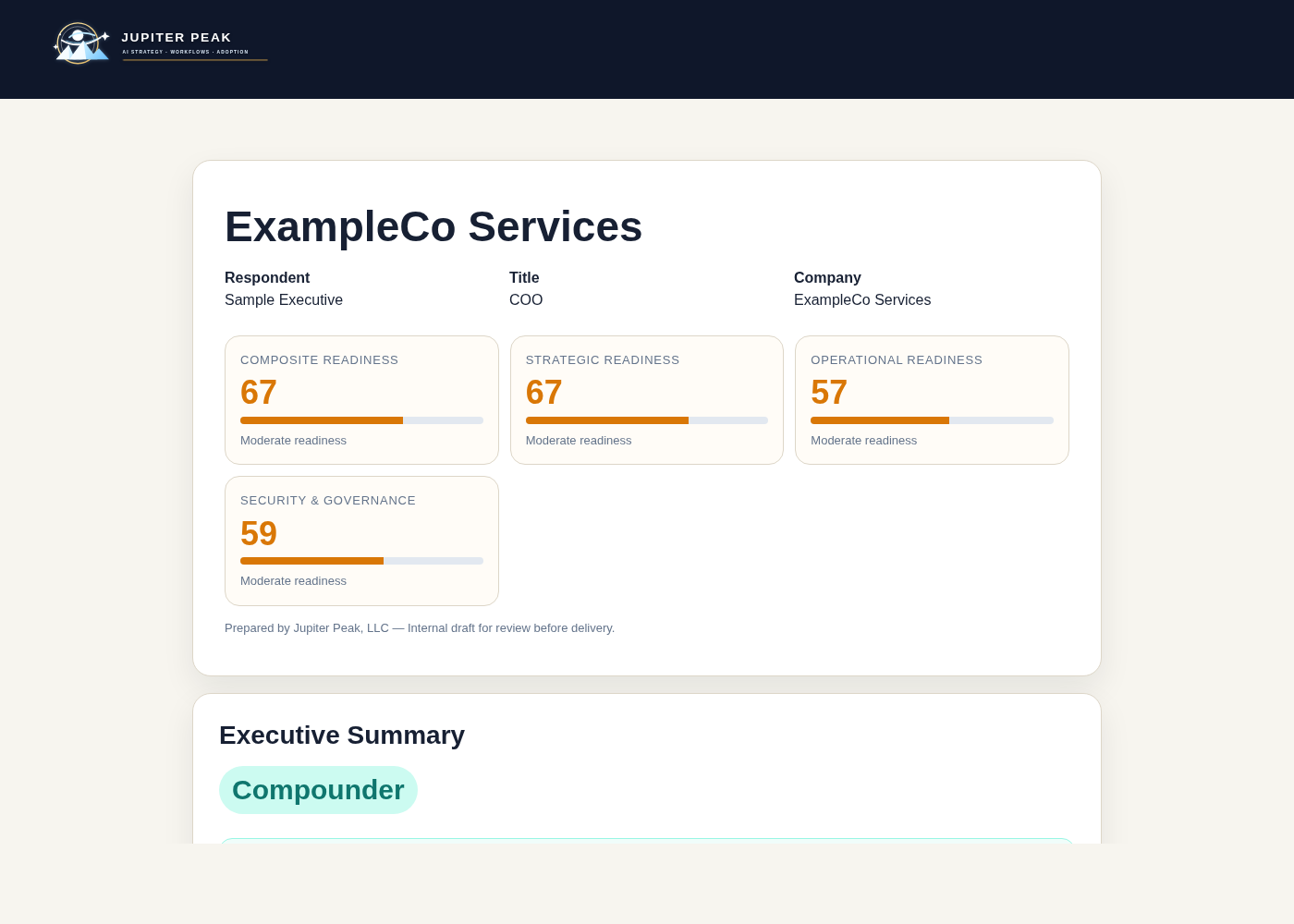
Redesign: the signal is real, but governance and operating-model debt still need work.
Recommended 90-day priority · De-risk first
Proposal response drafting
Use AI to assemble first-pass proposal sections from prior performance, reusable technical language, knowledge-base content, and client requirements.
Illustrative economic test
Assumption basis: Illustrative ranges assume proposal managers and SMEs spend 25-35 hours per week recycling prior responses, chasing source material, and manually checking draft quality. Value estimate uses avoided labor drag plus modest cycle-time improvement, not new contract revenue.
Governance findings before pilot
- Approved AI tool path is not yet confirmed for confidential proposal and pursuit data.
- Allowable proposal inputs have not been classified by data sensitivity, client restrictions, and reuse rights.
- Human review and sign-off responsibilities are not yet documented for AI-assisted proposal content.
90-day decision sequence
Run the Advisory Engagement: clear the three governance gates, assign executive/workflow owners, and baseline the proposal-response workflow.
Design the bounded pilot only after controls are documented; define success metrics, review checkpoints, and allowed data sources.
If gates are cleared, run the controlled pilot, measure pre/post outcomes, and decide whether to scale, revise, or retire the workflow.
The real problem
Most firms do not have an AI idea problem. They have a prioritization, execution, and governance problem.
Leaders are surrounded by possible AI use cases. The harder question is which ones deserve funding, which ones can actually make it into production, and which ones need governance, security, data, or operating-model work first.
What the Assessment answers
High-value workflows that are feasible, owned, measurable, and safe enough to start.
Use cases with promise but unresolved data, governance, process, or adoption gaps.
Ideas that look attractive on a slide but will not survive contact with real teams yet.
A practical sequence for foundation, pilot, controls, adoption, and measurement.
Illustrative ranked portfolio
Five workflows. One funded 90-day priority.
The ordering, scores, and dispositions below match the full sample report.
Use AI to assemble first-pass proposal sections from prior performance, reusable technical language, knowledge-base content, and client requirements.
Automate variance summaries and action recommendations for monthly operating reviews.
Summarize solicitation, contract, and modification requirements into compliance checklists for capture and delivery teams.
Draft weekly delivery summaries from project notes, ticket updates, and risk logs for internal leadership review.
Retrieve and summarize reusable past-performance examples, resumes, and project artifacts for capture and proposal teams.
What happens next
- DiagnoseThe Assessment starts with structured inputs about operating context, AI activity, and constraints.
- ScoreJupiter Peak calculates your F2L Score, then evaluates readiness, value, feasibility, risk, data posture, and adoption reality.
- PrioritizeThe best opportunities are ranked against work that should be secured, de-risked, deferred, or fixed first.
- RoadmapYou receive a practical 30/60/90-day sequence with owners, gates, and next decisions.
- DecideYour leadership team has a clear artifact for what to fund, secure, defer, or install next.
Assessment methodology
What the Assessment labels mean.
The Assessment uses three kinds of labels: an F2L Score that summarizes friction versus leverage, an organizational archetype that describes readiness to execute, and a use-case disposition that explains what to do with each AI opportunity next.
F2L Score bands
AI activity is creating more drag than leverage. Fix the operating, data, and governance foundation before funding serious build work.
The opportunity is real, but the system is not ready enough yet. Redesign the workflow, ownership, controls, or measurement before scaling spend.
You have leverage. Pick the highest-value workflow, fund a bounded pilot, and keep governance close to execution.
Organizational archetypes
Enough organizational readiness and outcome clarity to move beyond broad AI exploration. A Compounder usually has defined business goals, usable workflows, leadership attention, and enough operating discipline to start with a focused pilot, then compound gains across a larger program.
Plain English: you are not starting from zero. Pick the right first workflow and build momentum without creating governance debt.
The organization has enough readiness to execute, but outcome clarity is weak. There may be tools, data, talent, and executive interest, but the work is not yet tied tightly enough to a specific business result.
Plain English: you have ingredients, but the recipe is fuzzy. Tighten the outcome before funding the build.
The business knows what it wants AI to improve, but readiness gaps are likely to slow or distort execution. Common issues include process inconsistency, data gaps, governance debt, weak tooling, or unclear operating ownership.
Plain English: the target is real, but the foundation needs work before the pilot can scale safely.
The organization is interested in AI, but both outcome clarity and execution readiness are underdeveloped. Jumping straight into pilots would likely create noise, tool sprawl, and false confidence.
Plain English: start with the operating foundation, not the shiny use case.
Use-case dispositions
A use case with strong value, enough feasibility, and manageable risk. It is a good candidate for a focused pilot with clear success metrics, owner, scope, and adoption path.
Plain English: this is ready for controlled execution.
A high-value, feasible use case that should not be scaled until security, governance, data boundaries, or approval controls are addressed. The business case may be strong, but the risk profile is too high for a casual pilot.
Plain English: the idea is worth pursuing, but only after the guardrails are in place. Secure First is not a no; it is a sequencing decision.
A use case with meaningful potential, but feasibility is not yet strong enough. The blocker may be unclear ownership, unstable process, weak data access, immature tooling, or adoption uncertainty.
Plain English: validate and reduce the biggest execution risk before committing to a full pilot.
A use case that may be attractive, but a hard readiness gate is active. This can include missing governance, unresolved data controls, no clear owner, or a process foundation too weak for reliable AI execution.
Plain English: fix the operating foundation before building on top of it.
A use case that does not currently justify near-term investment based on value, feasibility, risk, or readiness. It may be revisited later after higher-priority work creates better conditions.
Plain English: not now. Spend scarce attention somewhere better.
Related thinking
Read the operating argument behind the Assessment.
Fixed-Fee Executive Diagnostic
$5,000 fixed-fee diagnostic
This is not a free lead magnet or generic AI maturity quiz. It is a focused diagnostic for leaders who want a serious answer before committing to a larger AI strategy or implementation effort.
Note on Pricing: Introductory validation pricing has ended. The standard AI Opportunity Assessment is $5,000, with private payment and intake provided after fit is confirmed.
See a Sample AssessmentWho is this best for?
CEOs, COOs, founders, and operating leaders at firms that already know AI matters but need clarity on what deserves executive attention first.
Is this a consulting engagement?
No. It is a paid diagnostic. It can lead to advisory or implementation work, but the initial deliverable is a clear decision artifact.
What do I need to provide?
Company context, current AI activity, readiness inputs, governance posture, and 1–5 candidate workflows you want evaluated.
How is Assessment data handled?
Jupiter Peak asks for the least sensitive information needed to complete the Assessment, and intake is designed to take about 25 minutes using sanitized workflow context. Avoid passwords, credentials, regulated personal data, and highly sensitive HR or legal material unless specifically discussed first. Approved AI tools may help analyze and draft internal working materials, and client confidential information is not used in public examples, marketing, or reusable training materials without permission.
Why is this a fixed-fee diagnostic instead of a free quiz?
The Assessment requires structured scoring, manual executive review, and a useful report. Free quizzes produce noise. This is meant to produce a decision.