
Notional worked example
The Peak Operating Loop in Practice: Meridian Federal Solutions.
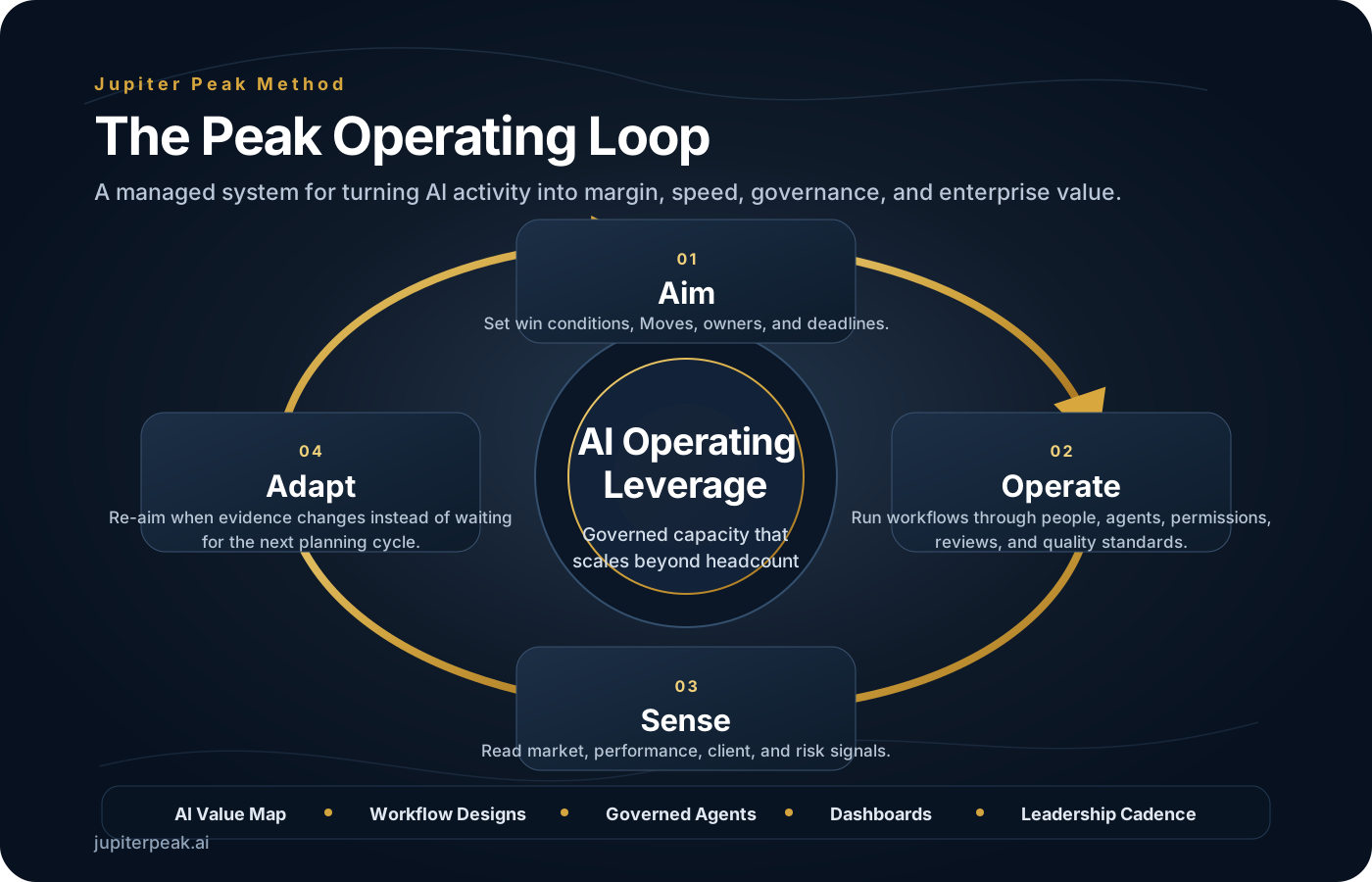
Meridian Federal Solutions is a notional example of a $42M federal services firm installing the Peak Operating Loop over 90 days.
The firm
A $42M federal data firm with linear growth economics.
Meridian Federal Solutions is a 12-year-old data engineering and analytics services firm headquartered in Tysons Corner, Virginia. Founded by CEO Marcus Chen, a former agency data engineer, the firm runs at $42M revenue with 180 employees.
Meridian serves civilian agencies: prime on a Treasury OIG data modernization contract worth $8M annually, subcontractor to a top-10 prime on $14M of HHS health data work, and prime on a DOL employment statistics platform worth $6M annually. It graduated 8(a) three years ago and has held its own in full-and-open competition since.
Marcus’s problem is familiar: every new dollar has required roughly a dollar of new payroll. Pricing pressure is rising. Every agency RFP mentions AI. Meridian has scrappy demos, but nothing in production. Its EOS-flavored cadence got the firm here, but Marcus knows it will not get them where he wants to go.
Economic Baseline
The scoreboard before anything changes.
The first artifact is the Economic Baseline: where Meridian actually stands before the Loop is installed. The Peak Operating Loop passes its quarterly Economic Test only when at least one economic outcome, at least one flow or leverage measure, and at least three measures overall improve; no measure materially degrades; and the retention, delivery-quality, and regrettable-attrition guardrails hold.
| Baseline measure | Starting point |
|---|---|
| Revenue per employee | $233K |
| Gross margin | 32% |
| Proposal and sales cycle time | 18 days median |
| Delivery cycle time | Roughly 6 weeks for a standard analytics deliverable |
| Management attention | High: pricing decisions, staffing calls, and escalations route through Marcus or two VPs |
Meridian records a 35% firm-fixed-price, 55% cost-reimbursable and T&M, and 10% productized contract mix. Before setting targets, it selects addressable-portfolio scoring: revenue per employee and gross margin are scored on the fixed-price and productized share, while delivered scope per labor hour and fee realization are tracked on the cost-type book. Each measure has a written start point, end point, inclusions, and exclusions.
Management attention uses all six JP-POL-MAL-001 categories, including approval exceptions against the delegation-of-authority path. Meridian corroborates executive-meeting counts against the calendar and reports weekly Log completeness beside the normalized count.
Illustrative example: Meridian Federal Solutions is fictional. These results show how the methodology and Economic Test could be applied; they are not client results or guaranteed outcomes.
The Core
Values become runtime rules for people and agents.
Meridian’s values are not a poster. Each value is enforced in the human layer and the agent layer through the Two-Layer Operating Model.
Humans write the agency outcome into every project plan. Agents reference the agency objective before acting and refuse drift without re-confirmation.
Humans document data lineage and route reports through QA. Agents cite sources, flag confidence, and say when a claim cannot be verified.
Humans peer-review before client submission. The orchestrator agent reviews subagent output, and two failures trigger stop and escalation.
Humans surface blockers at standup. Agents report stalls and partial completions in real time, never optimistic status.
Humans keep commitments the contract does not require. Agents take no external or destructive action without human confirmation.
Summit and Field Map
The strategic core fits on one operating page.
Make every civilian agency Meridian serves able to answer its hardest data question in minutes, not months.
Data engineering and analytics services for civilian federal agencies in the $50M to $500M agency budget band, concentrated in Treasury, HHS, and DOL.
Civilian agency CIOs, CTOs, and Chief Data Officers with 12- to 36-month analytics modernization initiatives funded.
Founder-operator federal AI credibility, an AI-native delivery model at roughly 60% of peer labor cost, and the Civic Insight platform.
The Civic Insight Method: data assessment to deployed analytics in 90 days using agent-augmented teams from day one.
If a deployable analytics workflow is not live within 90 days of kickoff, the final milestone is not billed.
Every initiative opens with a written, signed win condition. The PM cannot kick off without one. The proposal agent cannot produce a final draft without one in the source materials.
Aim
Four Q4 Moves define what matters now.
2030 vision: $100M revenue with under 260 employees, revenue per employee rising from $233K to $385K, and recognition as the civilian agency analytics partner that turns quarters into days.
2027 goals: $52M revenue, 25% from productized offerings, three civilian agencies live on Civic Insight, five AI agents in production, and a three-person AI Operations function.
- Ship the Civic Insight pilot at Treasury OIG. Win condition: documented agency adoption decision by December 15. Owners: Marcus Chen and Yvonne Reyes. Economic claim: increase fixed-price and productized revenue contribution and improve gross margin.
- Cut proposal response time from 18 days to 9. Win condition: median response time across November and December submissions is 9 days or less. Owner: VP of Business Development. Economic claim: reduce proposal and sales cycle time by approximately 50%.
- Hire a Director of AI Operations. Win condition: signed offer accepted by November 30, start by January 5. Owner: COO. Economic claim: reduce normalized management-attention events by improving operating ownership.
- Put the contract data tagging agent into production. Win condition: 100% of new contracts tagged within 48 hours, manual correction under 2%. Owner: Director of Data Engineering. Economic claim: reduce delivery cycle time for contract setup.
Operate
The Operating Seat Map now has human seats and agent seats.
Every managed-agent seat carries all eleven requirements: business owner, mandate, win condition and economic claim, permissions, external-action boundaries, escalation rules, output contract, quality standards, review cadence, logging and evidence retention, and a retirement or re-scope condition. An agent missing any one is unmanaged and does not belong on the map.
Reports to the VP of Business Development, manages drafting, compliance-check, and technical-volume subagents, cites sources, never fabricates past performance, and stops after two failures. Win condition: Move 2.
Reports to the Director of Data Engineering, tags high-confidence matches, flags ambiguity, and reports daily on what it could not process. Win condition: Move 4.
Checks operating hygiene without destructive authority.
Handles internal support with named ownership and confirmation gates for external or destructive action.
Sense
Nine signal streams feed the weekly digest.
Nine always-on agents feed Meridian’s weekly signals digest, owned by the COO: Opportunity Radar, Policy Watcher, Relationship Signal, Competitive Radar, Client Signal, Internal Signal, Engagement Signal, Improvement Signal, and the Values Agent.
Values is one of seven required review functions. Meridian also covers Marketing Strategist, Customer/Buyer, Market, Governance/Risk, Operating Performance, and Weekly Improvement/synthesis. The nine agents above may cover multiple functions, but every function records an explicit weekly disposition. Meridian tailored the Jupiter Peak six-value default into five company values, each with human and agent runtime rules.
Any signal proposed at Level 3 or above is scored on evidence, magnitude, confidence, urgency, and reversibility before leadership discussion. A Level 4 recommendation also records why waiting until the next planning boundary is economically worse.
Loop Meeting
A Monday morning shows the Loop operating.
At 8:00 a.m. on Monday, November 17, 2026, Meridian’s leadership team meets for the weekly Loop Meeting. Marcus chairs. Dana Liu, COO, presents the Loop Dashboard. Priya Aggarwal, chief of staff, maintains the Adapt list and captures decisions.
- Opening: wins, recognition, and material changes since the prior meeting.
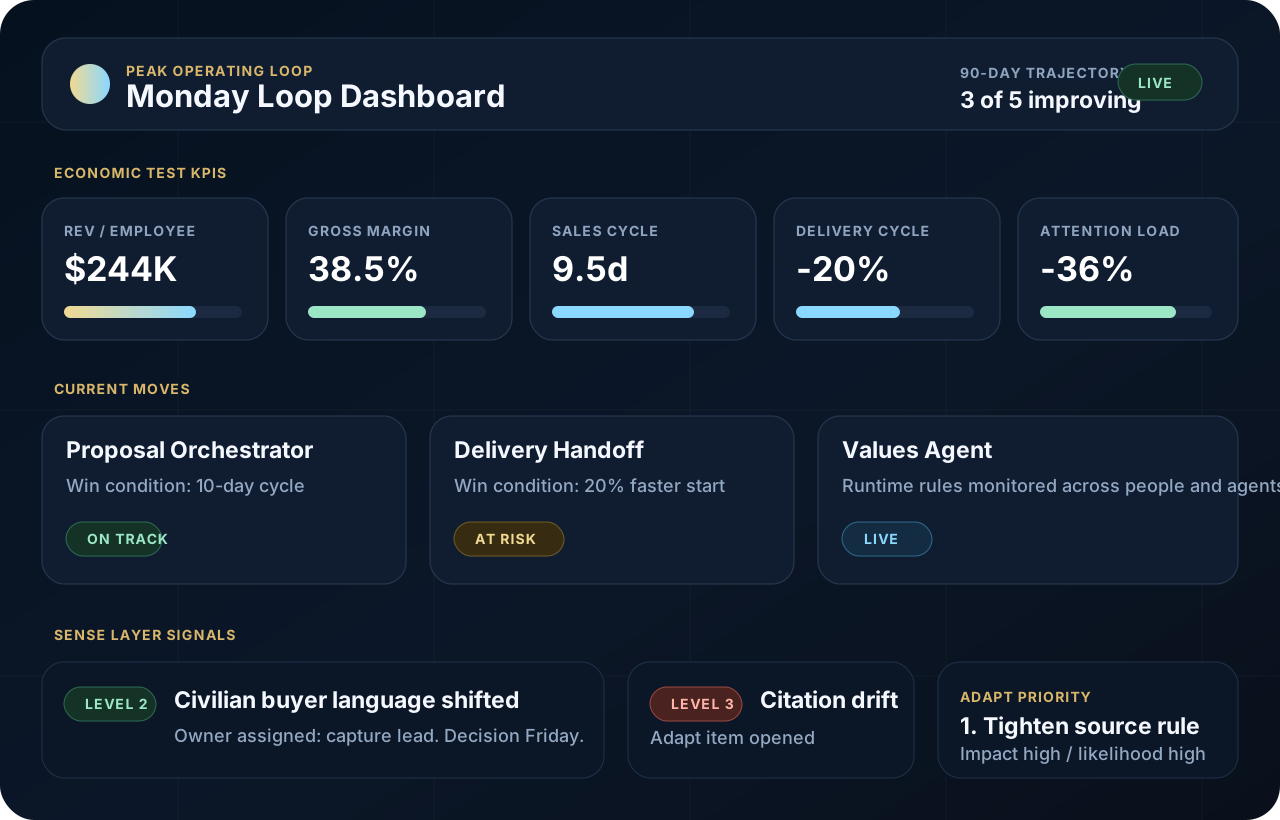
- Economic Test trajectory: revenue per employee is tracking at $244K, gross margin holds at 34%, proposal cycle time has dropped to 12 days, delivery cycle time is unchanged, and normalized management-attention events are down. The weekly view shows three of five numbers moving in the right direction; it does not declare the quarterly Economic Test passed.
- Move status: Civic Insight is on track; proposal cycle is yellow at 12 days; AI Operations hiring is on track; contract tagging is live at 100% first-week accuracy.
- Headlines and Sense: Policy Watcher flags an OMB AI-readiness memo as Level 4, Competitive Radar flags a top-three prime’s aggressive platform pricing as Level 3, and Values flags proposal-orchestrator drift against “truth on the page.”
- Task review: owners call each priority commitment on track or off track.
- Adapt: leadership identifies, discusses, and solves the highest-priority items. Marcus owns the OMB response, Raj Patel owns pricing-pattern analysis, and Emma Park owns the citation-rule fix.
- Conclusion: Priya confirms decisions, owners, due dates, cascading messages, and the meeting effectiveness rating.
The Loop Dashboard was published as a ready pre-read with source-data and render times before the meeting, so segments 2, 3, and 5 run by exception. The meeting runs 52 minutes. Four items resolved. Four named owners with four win conditions. Next Monday, the team starts by closing the loop on each.
At the first meeting of the next quarter, Meridian runs the extended Quarter-Boundary Loop Meeting: it runs the quarterly Economic Test and claims ledger, reviews guardrails, revises the Move set, reviews Operating Seat Map performance, reallocates capacity and budget, and sets the next 90-day targets.
Adapt
The Loop buys six to eight weeks of positioning advantage.
By Friday, Marcus and Dana hold the focused Adapt session assigned in the Loop Meeting. Q1 2027 Moves are pre-defined: Civic Insight productization accelerates from Q2 to Q1, the BD target list is rewritten against the new demand pattern, and the Director of AI Operations hire is escalated.
By the time the memo’s deadlines bite in Q1, Meridian is positioned while larger primes are still mobilizing. The Sense Layer caught the signal on Friday; the Loop resolved it by Monday.
Five working artifacts
The Route replaces the strategy deck.
- Economic Baseline: the five starting numbers captured in the Assessment.
- Summit and Field Map: Summit, Field, Buyer, Edge, Approach, and Promise on one page.
- Move Scorecard: Q4 Moves with owners, win conditions, metrics, and decision deadlines.
- Operating Seat Map: every required company capability and accountable human, managed-agent, or hybrid seat.
- Loop Dashboard: KPIs, 90-day trajectory, Move status, nine signal streams, and the Adapt list.
90-day trajectory
Five of five 90-day trajectory targets hit or beat target.
| Metric | Baseline | 90-day target | 90-day actual |
|---|---|---|---|
| Revenue per employee | $233K | $245K | $244K run-rate (+4.7%) |
| Proposal cycle time | 18 days | 9 days | 9.5 days (-47%) |
| Delivery cycle time | 6 weeks | 4.8 weeks | 4.8 weeks (-20%) |
| Gross margin | 32% | 34% | 34.5% (+2.5 pts) |
| Executive escalations | 14/week | 9/week | 9/week (-36%) |
Illustrative results: Meridian Federal Solutions is fictional. The figures below demonstrate the Economic Test and are not client results or guaranteed outcomes.
Two additional indicators are tracked: AI-supported workflows in production move from 1 to 3 live, and the Values Agent’s net alignment signal trends positive after the week-four citation-rule fix.
What changed
Meridian becomes the same firm with a faster reflex arc.
Meridian is not a different firm because it installed the Peak Operating Loop. It is the same firm with a faster reflex arc and a dashboard that shows whether it is moving toward operating leverage.
The values they had become rules their agents follow at runtime. The vision they had becomes a signal they can act on. The discipline they had becomes the floor the AI leverage stands on. The weekly trajectory shows whether Meridian is on pace; the quarterly Economic Test over the rolling four-quarter window determines whether economic leverage actually occurred.
Install the Loop
Start with the front-door diagnostic, or apply for the federal cohort.
The Assessment is the primary path for firms deciding what to build, de-risk, secure, defer, or fix first.
Implements JP-POL-CANON-001, methodology v2.0 Approved · Last reconciled August 11, 2026